Mantrailing vs Tracking: The Win – Stay, Lose – Shift concept.
Win – Stay, Lose – Shift concept in Trailing Dogs.
This something you will see every single trail, as well as in daily life. It’s an intrinsic part of learning for both dogs and handlers, it’s putting into words the moment where the dogs are learning how to solve this, vs trying things to see what happens.
You’re putting words to the moment where the dog goes from:
“I know how to solve this”
to
“I’ll try something else then…”
…and that’s where a lot of mantrailing problems are born because we are encouraging problem solving, which we want, but not always in the way we want because we aren’t aware of it or planning ahead.
What is “Win–Stay, Lose–Shift”?
The win–stay, lose–shift strategy comes from learning theory and behavioral ecology.
It describes a very simple rule animals use when solving problems:
- If a behaviour works (win) → repeat it (stay)
- If a behaviour does not work (lose) → try something different (shift)
It’s an adaptive survival strategy seen across species because it is efficient. The animal doesn’t waste time overthinking. It simply follows reinforcement history, and if there is not enough history or too much history this effects the outcome.
Dogs do this constantly in training, searching, hunting, and trailing.
They are not thinking: “This is a contaminated track with cross-tracks and aged scent.”
They are thinking: “Last time this behaviour paid. This time it didn’t. I’ll try a different one.”
That’s win–stay, lose–shift in action in mantrailing.
What this looks like on a trail
A dog starts a trail using the strategy that has paid off before:
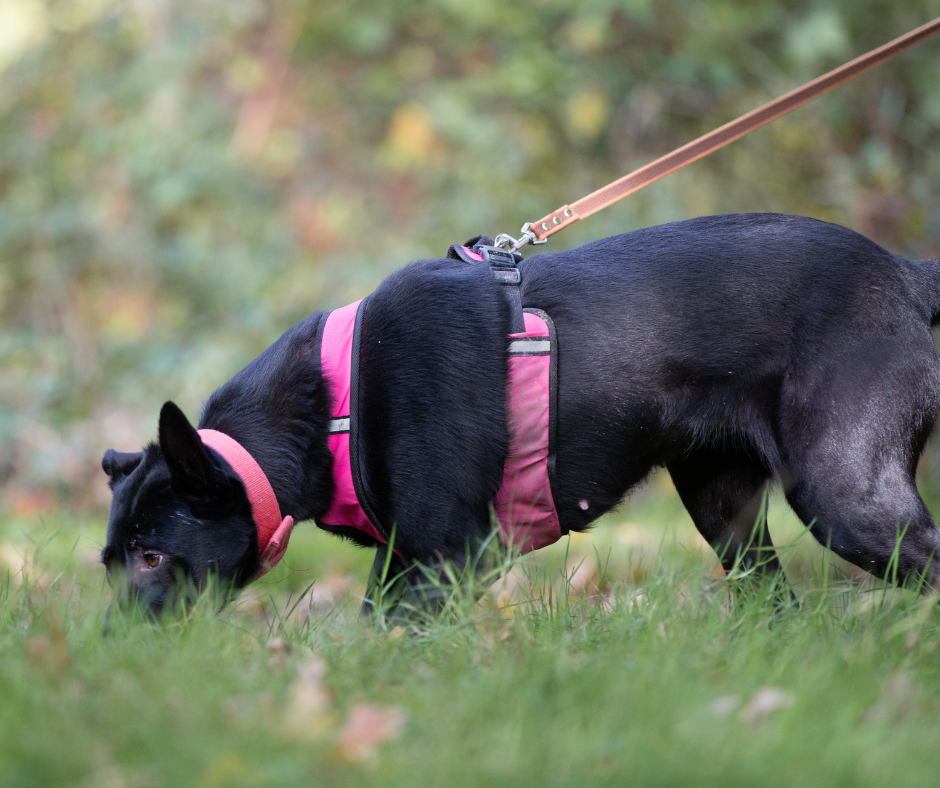
- Head down
- Following ground disturbance
- Pulling forward with commitment
- Working methodically
But then something happens:
- The scent picture changes
- The trail crosses harder ground
- The dog overshoots a turn
- The handler stops the dog
- The dog works correctly but doesn’t find the person quickly
From the dog’s perspective: “I did the thing that usually works… and nothing happened.”
That’s a lose. So the dog shifts. And what do they shift to?
Not better mantrailing in most cases. We become unable to read their behaviour on and off the trail.
They shift to any other strategy that has ever worked.
You start seeing:
- Casting wider and wider
- Air-scenting
- Speeding up
- Zig-zagging
- Searching for people instead of trailing a person
- Looking back to the handler
- Trying to go to obvious looking humans
This is not them just guessing it is strategy in play, the dog is following a very sensible learning rule.
Researchers have tested this rule in dogs using simple choice tasks.
In these studies:
- Dogs choose between options (e.g., under which cup a treat might be hidden).
- When their choice is rewarded, they tend to repeat it next time (“win–stay”).
- When a choice isn’t rewarded, they tend to try something different (“lose–shift”).
This pattern is seen in puppies and adult dogs, suggesting that win–stay, lose–shift is a basic learning rule dogs naturally use.
Reference Paper Evidence for Win–Stay, Lose–Shift in Puppies and Adult Dogs – https://cognitivesciencesociety.org/cogsci20/papers/0717/0717.pdf
Why this happens so often in mantrailing?
Mantrailing is full of delayed reinforcement. The dog can work correctly for minutes without feedback. They can make the right decision at a junction and nothing happens. They can be in scent and not get the “win” for a long time.
So from a learning perspective, mantrailing often looks like: Lots of “lose” before a single “win”.
That’s a problem.
Because the dog starts thinking: “The trailing behaviour itself is unreliable as a way to get rewarded.”
So they begin experimenting.
Handlers then say: “My dog is trying everything except trailing.” because we all know we’ve been there in that. Looking at the dog thinking what is happening here why have we got a shift in behaviour, especially when they were correct for so long. They go into lose–shift mode.
Why tracking often produces fast results where mantrailing failed
Tracking, especially in structured tracking work, is almost a perfect win–stay environment.
The dog experiences:
- Continuous scent under their nose
- Clear, consistent feedback from the ground
- Frequent micro-successes
- Predictable scent picture
- Very little ambiguity
So the dog learns: “Head down, methodical, slow, ground-committed behaviour = always works.” because they hit articles which give reward feedback, as well as not hunting for a large jackpot at the end. Instead they are looking for the reward to come from the trail itself.
That becomes deeply reinforced as the winning strategy. They stay with it. They don’t need to shift because they are constantly “winning”. When these dogs go back to mantrailing, something interesting happens:
They now bring that win–stay strategy with them.
Instead of: “This isn’t working, I’ll try something else”
They think: “This has worked hundreds of times. I’ll stay with it longer.”
Tracking has changed their problem-solving persistence. Not because tracking is “better”.But because tracking gave them so many wins in the exact behaviour we want in mantrailing:
- Patience
- Commitment to ground scent
- Working through difficulty without panic
- Not switching strategies too fast
But the dog is simply following learning theory perfectly.
Why understanding this changes how you train
When you understand win–stay, lose–shift, your goal in early and remedial mantrailing become to create as many wins for correct trailing behaviour as possible, using the correct reinforcement.
Not harder trails.Not more variables.Not more challenges. More clear success while the dog is doing the exact behaviour you want to keep.
Because once that behaviour has enough reinforcement history, the dog will: Stay with it when things get hard instead of shifting to nonsense.
The big insight for handlers
When a dog starts trying lots of different strategies on a trail, it is not because: “They don’t understand mantrailing.”
It’s because: “They no longer believe that trailing itself is the best way to solve the problem.”
Tracking rebuilds that belief very quickly because it removes ambiguity and floods the dog with wins for the right behaviour. Then, when they return to mantrailing, they are far more likely to: Win–stay instead of lose–shift.
And suddenly the handler says: “Mantrailing is working again.”
But what really changed was the dog’s learning history, not the dog’s ability.
Dogs don’t abandon trailing because they’re confused.
They abandon it because, from their learning history, trying something else makes more sense.
This is the topic of of the March Mantrailing Membership Webinar – check it out here